








Miele Dryer Repair in Los Angeles and Orange County
Almost every Miele dryer sold here is a heat-pump or condenser machine, and that single fact explains most of the calls we get. These dryers do not vent outside; they pull moisture out of the air and give it back as water. Anything that restricts airflow, whether lint in the filters, an encrusted plinth filter or a blocked heat exchanger, shows up as long cycles and damp laundry long before anything actually breaks.
We repair Miele tumble dryers in homes across Los Angeles and Orange County, and we will tell you honestly when a machine needs cleaning rather than parts.

What we find behind the symptoms
| What you see | What is usually behind it | Who fixes it |
|---|---|---|
| Laundry still damp at the end of a program | Overloaded drum, laundry that went in too wet, or lint filters that have not been cleaned; on heat-pump machines, an encrusted plinth filter | All of these are yours to check first |
| Cycles are getting longer month by month | A heat exchanger gradually loading up with lint, which quietly reduces the airflow | Cleanable on most models; a technician if it is sealed |
| Dryer runs but produces no heat | A failed heat pump circuit or heater, or a sensor telling the control the wrong temperature | Technician |
| Drum turns with a squeak or a rumble | Worn drum rollers or belt tensioner, both wear items on a machine with years on it | Technician |
| Machine stops shortly after starting | An overloaded drum, an obstructed ventilation grille under the door, or a faulty door contact | Load and grille are yours; the contact is a technician |
| Water tray fills far more slowly than it used to | The condensation is not being collected, which usually means restricted airflow rather than a broken pump | Start with the filters |
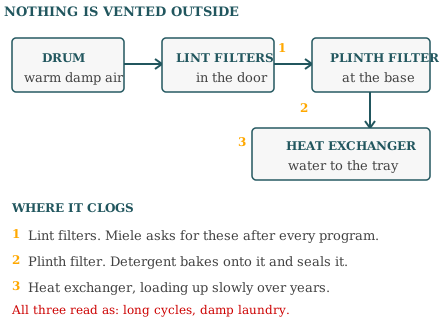
Nothing is vented outside, so anything that restricts air shows up as time.
What the fault codes mean
| Code | What Miele says it is |
|---|---|
| F55 | The laundry is still not dry after the maximum drying time of 180 minutes, on residual moisture programs. Miele lists three causes: the drum is too full, the laundry went in too wet and needs a higher spin speed in the washer, or the lint filters are soiled. |
| F66 | Points at airflow across the whole machine: lint filters, an encrusted plinth filter, a heat exchanger that needs cleaning, an overloaded drum, an obstructed ventilation grille under the door, or a room too small and too warm for a condenser dryer to reject its heat into. |
| F50 | Miele gives three readings: the drum is too full; a software hiccup after the door was opened mid-cycle, which switching the machine off and straight back on clears; or a genuine technical fault. |
| F36 | The door contact, the reed switch, is faulty. Not a user repair. |
Code meanings are taken from Miele customer support, mieleusa.com, checked in August 2026. Codes vary between model generations, so treat the display message as the starting point rather than the diagnosis.
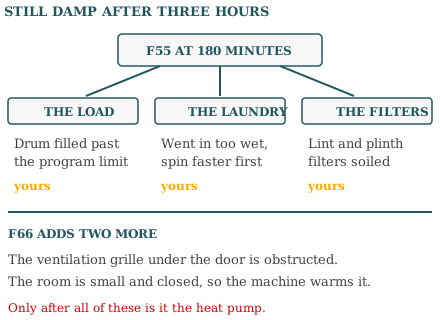
Five of the causes are yours. The heat pump is the last suspect, not the first.
What you can check yourself
- Clean both lint filters in the door opening. Miele asks for this after every program, and it is the single most common reason a dryer stops drying.
- Find the plinth filter behind the flap at the bottom of the machine and check whether it is encrusted rather than merely dusty. Detergent residue bakes onto it.
- On models with an accessible heat exchanger, open the access panel and rinse it out, then wipe the surrounding lint away with a damp cloth without damaging the seal.
- Do not fill the drum past the maximum load for the program you chose. A full drum on a delicate program will hit the 180 minute limit and stop.
- Spin the laundry at a higher speed in the washer before drying. Wet laundry in, long cycle out.
- Clear anything blocking the ventilation grille under the door, and open a window if the machine lives in a small closed room.
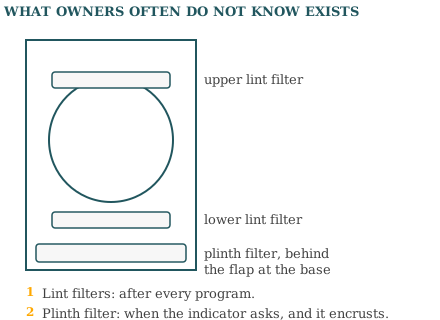
The plinth filter is the one owners most often do not know exists.
Where to stop
Stop if the drum squeaks or rumbles, if the machine trips a breaker, if there is a burning smell, or if F55 or F66 come back after the filters and heat exchanger are genuinely clean. At that point the fault is in the heat pump circuit or the sensors, and that needs measurement.
Call C&C Appliance Repair at (800) 860-0974 for same-day service across Los Angeles and Orange County.
Questions we get asked
Why does my Miele dryer take three hours and still leave laundry damp?
That is F55 behaviour: the machine hit its 180 minute ceiling on a residual moisture program. Miele attributes it to an overfilled drum, laundry that went in too wet, or soiled lint filters. Work through those three before suspecting the heat pump, because in our experience the filters explain most of these calls.
What is the plinth filter and why does it matter?
It is the filter behind the flap at the bottom of the machine, in front of the heat exchanger. Detergent residue bakes onto it over time and it stops being a filter and starts being a wall. Miele calls it out specifically in the F66 troubleshooting, and it is the part owners most often do not know exists.
Does a Miele heat-pump dryer need a vent?
No. It condenses the moisture and collects it in a tray or pumps it to a drain, which is why it can be installed in a closet. It does still need air movement around it: in a small closed room the temperature rises and the machine loses efficiency, which Miele names as a cause of F66.
The dryer stopped a minute after I opened the door to add a towel.
That matches the F50 note in Miele's own troubleshooting: opening the door mid-cycle can produce a software fault about a minute later. Switch the appliance off and straight back on. If F50 keeps coming back, it is the technical fault reading instead.
Is a squeaking drum worth fixing?
Yes, and early. Rollers and the belt tensioner are wear parts, and replacing them is routine. Running a dryer until the noise becomes a grind risks the drum and the shaft, which turns a modest repair into a large one.
Also we repair
- Sub-Zero appliances
- Viking appliances
- Bosch appliances
- Thermador appliances
- Dacor appliances
- Wolf appliances
- Asko appliances
- KitchenAid appliances
- Fisher & Paykel appliances
- DCS appliances
Related pages
- Dryer repair, all brands
- Dryer not heating: what to check
- Dryer squeaking: what the noise means
- Miele appliance repair
Where we work
Los AngelesBeverly HillsSanta MonicaEncinoCalabasasGlendaleBurbankPasadenaIrvineNewport BeachCosta MesaHuntington Beach
Not sure whether your address is in our area? Call (800) 860-0974 and ask, it takes a minute.















Customer reviews

