










Dryer Squeaking: What Is Making the Noise and What to Check
A squeal from a dryer comes from what holds the drum up, not from the drum itself. The drum rides on rubber rollers at the back and on felt or plastic glides at the front, and the belt around it is kept tight by a spring loaded idler pulley. When any of those wears flat or dries out, the drum drags and squeals. The sound tells you a lot before anything is opened: a steady squeal that builds as the machine warms up is the rollers, a squeal from the first second is the idler or the motor, a scrape is the front glides, and a rattle that rises and falls with the airflow is something loose in the blower.
What causes it
| Cause | What you see | Who fixes it |
|---|---|---|
| Worn drum rollers | Steady squeal that follows drum speed and grows louder as the dryer warms up | Technician |
| Idler pulley bearing | High squeal or chirp from the first second of the cycle | Technician |
| Worn front glides or felt seal | Scraping sound, bright wear marks on the drum lip, sometimes marks on clothes | Technician |
| Stretched or cracked belt | A thump once per turn, then a motor that runs with the drum standing still | Technician |
| Coin or button in the blower | Rattle or ticking that rises and falls with the airflow, not a squeal | You can clear it |
| Motor bearing | Squeal that carries on for a second after the dryer is switched off | Technician |

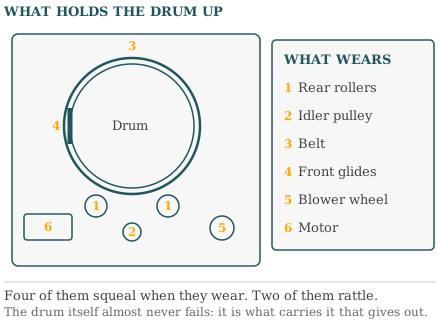
Six parts move. Four of them squeal when they wear.
What you can check yourself
- Run the dryer empty for a minute. A noise that is unchanged with an empty drum is mechanical, not the load.
- Listen for when it starts. From the first second points at the idler or the motor, after ten minutes of warming up points at the rear rollers.
- Open the door and turn the drum by hand. A rough spot or a grinding you can feel through the drum is a rear roller.
- Run a hand around the front lip of the drum opening. Flattened or missing felt lets the drum rub metal on metal.
- Check the lint trap housing and the blower for coins, pen caps and buttons. This is the one noise on the list you can clear yourself.
- Push the cabinet level and steady. A dryer rocking on an uneven laundry floor adds its own noise and masks the real one.
Where to stop
Stop at the cabinet. Reaching the rollers, the pulley or the belt means taking the front or the top of the dryer off, unplugging the door switch and lifting the drum out with the belt held in place, and it is easy to pinch the belt or bend the bulkhead putting it back together. Stop sooner if the squeal has turned into a grind: that is a bearing close to seizing, and every extra load risks the belt burning through or the drum scoring the front panel.
Call C&C Appliance Repair at (800) 860-0974 for same-day service across Los Angeles and Orange County.
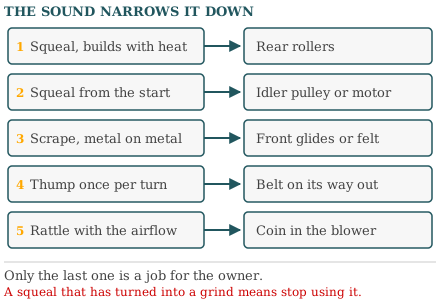
The sound narrows it down before anything is opened.
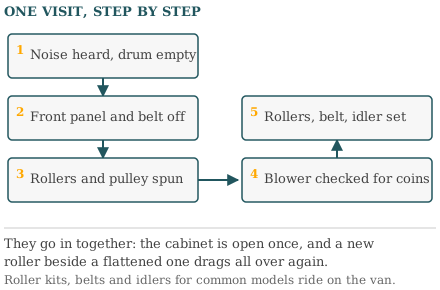
Why the rollers, the belt and the idler go in together.
Questions we get asked
Is it safe to keep using a squeaking dryer?
For a few loads, if it is a squeal and not a grind. A grind is metal on metal, and it either scores the drum or seizes and burns the belt. That turns a roller kit into a much larger repair.
The noise only shows up once the dryer is warm. Why?
Rollers with worn bearings run quietly while the grease is cold and stiff, then start to squeal as the cabinet heats and the grease thins. It is the most common pattern we hear.
Should the rollers be replaced as a set?
Yes. They wear at the same rate, and one new roller beside a flattened one puts the drum out of line. We fit them as a set with the belt and the idler while the machine is open, because the labour is the same either way.
Can I just oil the rollers?
No. The bearings are sealed, and oil on the shaft collects lint into a paste that wears the shaft faster. Once they squeal, they get replaced.
Which brands do you work on?
All of them, including Whirlpool, Maytag, LG, Samsung, Electrolux, Bosch, Miele, Speed Queen and Asko, gas and electric alike.















Customer reviews

