









Refrigerator Leaking Water: Where It Comes From and What to Check
Water on the floor in front of a refrigerator almost never comes from the sealed cooling system. It comes from one of three water paths: the defrost drain that carries meltwater to a pan under the compressor, the supply line that feeds the ice maker and the dispenser, and plain condensation from a door that no longer seals. Where the water shows up tells you which one. Under the crisper drawers means the defrost drain, at the front grille means the pan, behind the unit means the water line, and wet walls inside mean the door.
What causes it
| Cause | What you see | Who fixes it |
|---|---|---|
| Clogged defrost drain | Water under the crisper drawers, a sheet of ice on the freezer floor | You can clear it |
| Frozen ice maker fill tube | Hollow or missing cubes, ice building up in the corner of the freezer | You can thaw it |
| Door not sealing | Sweating walls, frost near the hinge, water running down inside the door | You can check it |
| Cracked or overflowing drain pan | Puddle at the front grille with nothing wet inside the cabinet | Technician |
| Leaking inlet valve or supply line | Water behind the unit, worse right after the ice maker fills | Technician |
| Unit tilted forward | Water runs out of the doors instead of into the drain | You can level it |

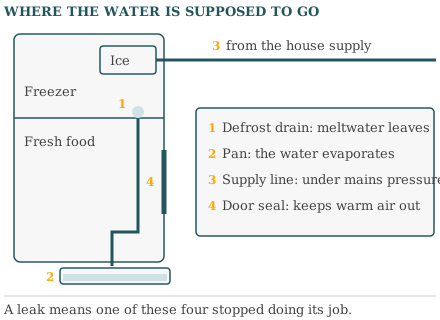
Three water paths. A leak means one of them stopped working.
What you can check yourself
- Note where the water is before you mop it up. That single fact narrows six causes down to one or two.
- Unplug the refrigerator before you reach behind any panel at the back of the freezer.
- Look at the freezer floor. Ice under the bottom basket means the defrost drain is blocked and the meltwater has nowhere to go.
- Pour warm water slowly into the drain hole at the back of the freezer floor. If it backs up instead of running away, the drain is plugged with ice or debris.
- Close the door on a dollar bill and pull it out. If it slides free with no drag, the gasket is not sealing at that spot and warm air is condensing inside.
- Take a flashlight to the supply line behind the unit and look for damp fittings and a wet patch on the wall. Look, do not wrestle a full refrigerator across a tile floor.
Where to stop
Stop when the drain runs clear, the gasket seals and the water keeps coming, and stop straight away if the leak is at the inlet valve behind the unit. That valve sits under mains pressure next to line voltage, and the pan under the compressor is only reached by pulling the unit out and dropping the rear panel. Built-in units make it harder still: on a Sub-Zero the drain and the pan sit behind a fitted panel, so the floor is usually wet long before anything is visible inside.
Call C&C Appliance Repair at (800) 860-0974 for same-day service across Los Angeles and Orange County.
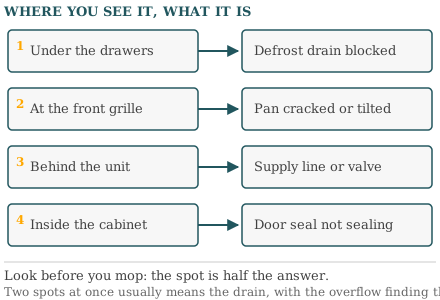
Where the water shows up narrows it to one cause.
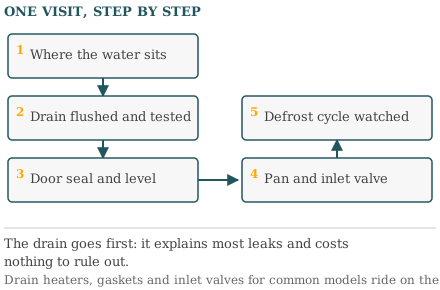
What the visit looks like when the drain is clear and water keeps coming.
Questions we get asked
Is water under the crisper drawers a leak?
It is meltwater from the normal defrost cycle that could not reach the drain. The drain is blocked, almost always with a plug of ice over food debris. Clear it and the puddle stops.
The floor is wet but the inside is dry. Where is it coming from?
Look at the front grille. The pan under the compressor collects defrost water and lets it evaporate. If that pan is cracked, or the unit sits tilted forward, the water ends up on the floor instead.
Can I keep using the refrigerator while it leaks?
It usually cools fine, so for a day or two yes, but keep the floor dry. Water sitting under a heavy appliance ruins hardwood and swells laminate, and that repair costs more than the refrigerator one.
Water only appears after the ice maker fills. Why?
Then it is the fill tube, the fill valve or the line feeding them. The valve opens for a few seconds per batch, so the leak follows the batches and looks random.
Which brands do you work on?
All of them, including Sub-Zero, Viking, Thermador, Miele, Bosch, KitchenAid, LG and Samsung. On built-in units the first sign is usually water on the floor, because the drain and the pan are hidden behind the panel.















Customer reviews

