









Dishwasher Leaking: Finding the Actual Source
A leaking dishwasher is a puzzle worth solving before anything is replaced, because the water almost never comes from where it appears. Six sources cover nearly every call: the door seal, the door itself out of alignment, the inlet valve, the drain hose or its clamp, the sump seal under the tub, and the supply connection under the sink. The first two are visible from the front. The rest need the machine pulled out.
What causes it
| Cause | What you see | Who fixes it |
|---|---|---|
| Worn or dirty door seal | Water runs down the front of the door, worse on hot cycles | You can check it |
| Too much detergent, or the wrong kind | Foam pushing out around the door, floor wet after every cycle | You can fix it |
| Leaking inlet valve | Water appears even when the machine is not running | Technician |
| Drain hose or clamp | Wet at the back or under the cabinet, worst at the drain stage | Technician |
| Sump or pump seal | Water under the middle of the machine, tub looks fine | Technician |
| Supply connection under the sink | Cabinet floor damp, dishwasher itself dry inside | Plumber or technician |

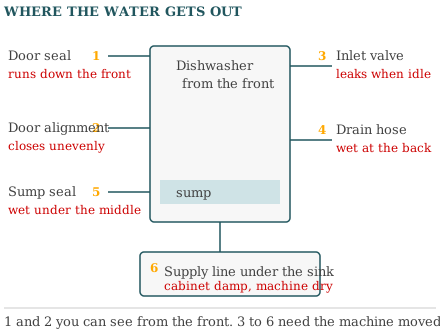
Six sources. Where the water shows is rarely where it starts.
What you can check yourself
- Run a cycle and watch. Where the water first shows tells you more than the size of the puddle: front of the door, back of the machine, or under the sink cabinet.
- Open the door and run a finger round the seal. Look for food debris, hardened grease, splits and flat spots.
- Close the door on a sheet of paper at three points across the front. If it pulls out easily anywhere, the door is not sealing there.
- Halve the detergent for one cycle. If the floor stays dry, it was foam, not a fault.
- Open the cabinet under the sink and feel the supply line and the drain connection with a dry paper towel.
- Check whether the puddle appears when the machine is idle. Water with the machine off means the inlet valve, not the tub.
Where to stop
Stop when the seal is clean, the door closes evenly and the leak still happens. The inlet valve, the sump seal and the pump are under the machine, and pulling a dishwasher out from under a stone worktop without marking anything is the part people regret doing themselves.
Call C&C Appliance Repair at (800) 860-0974 for same-day service across Los Angeles and Orange County.
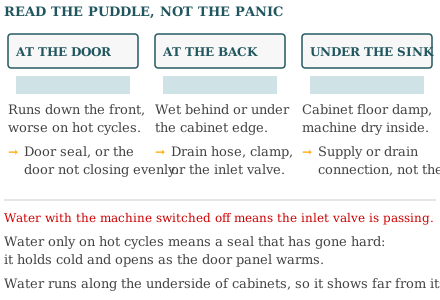
Front, back or under the sink: each points somewhere different.
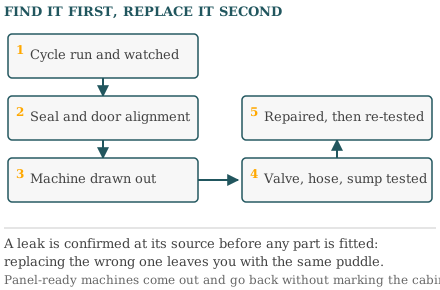
Finding the source before replacing anything.
Questions we get asked
There is water on the floor but the dishwasher looks dry inside. Where is it from?
Usually the supply or drain connection under the sink, or the drain hose behind the machine. Water runs along the underside of the cabinet and shows up at the front, several feet from where it started.
Water appears even when the dishwasher is not running. What does that mean?
The inlet valve is passing. It should hold the house water pressure closed between cycles, and when it fails, water trickles into the tub or down the outside of the machine with the appliance switched off.
Can too much detergent really flood the kitchen?
Yes, and it is one of the more common causes we find. Foam does not respect a door seal. Regular dish soap in a dishwasher will do it every time, and so will an overdose of powder in soft-rinse cycles.
The leak only happens on hot cycles. Why?
A seal that has hardened stays sealed when cold and opens up when the door panel expands with heat. It also points at the seal rather than at the plumbing, since a bad connection leaks at any temperature.
Is a leaking dishwasher urgent?
Urgent enough not to run it again. Water under a dishwasher goes under the cabinets and the flooring, where it does damage that costs many times the repair before anyone sees it.















Customer reviews

